Future Tech – Glossary

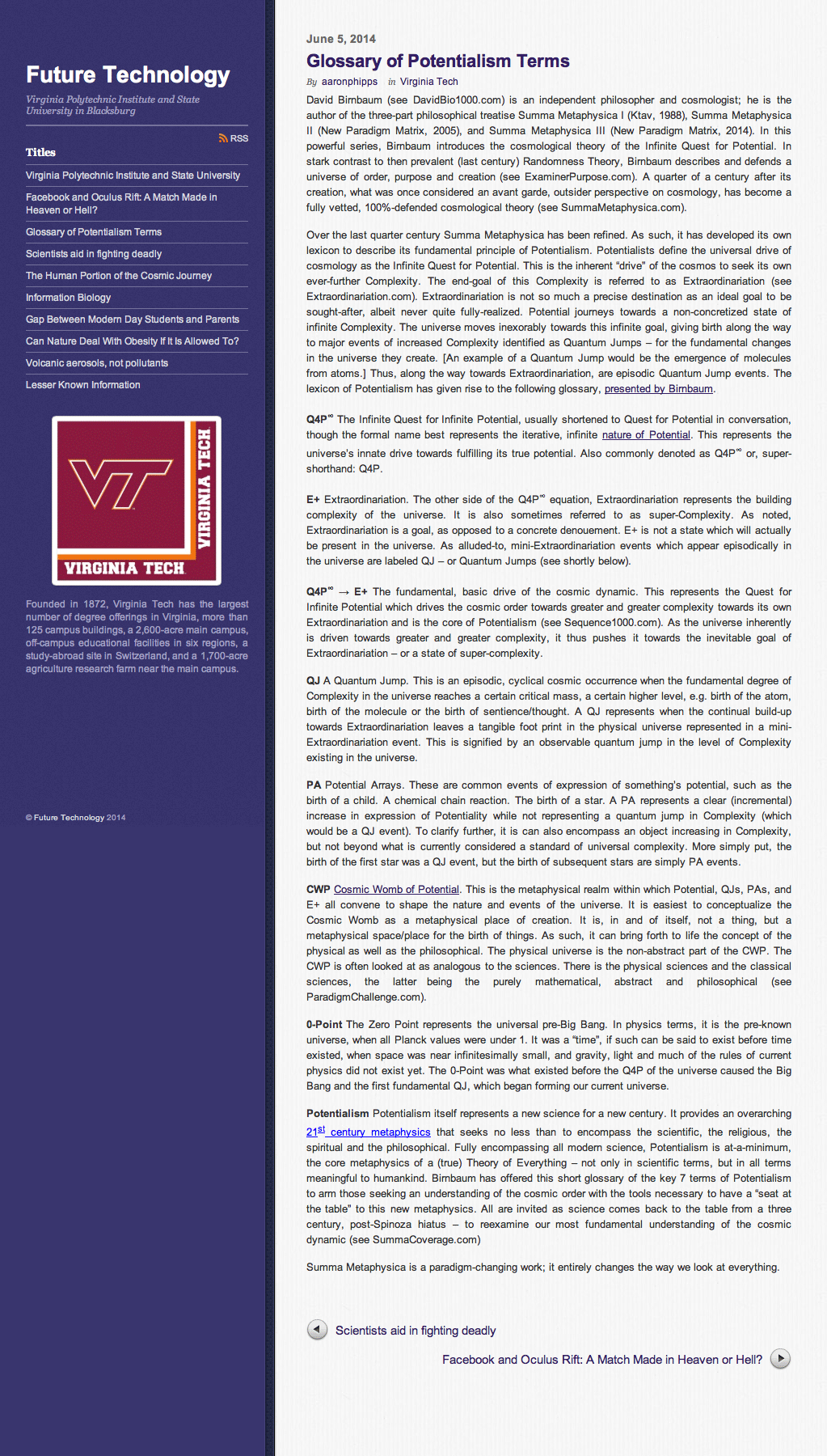
June 5, 2014

Future Tech –
Glossary

Iconoclast David Birnbaum philosophy cracks the cosmic code. His Summa Metaphysica  proposes a true Theory of Everything.


DAVID BIRNBAUM PHILOSOPHY / METAPHYSICS


Cosmology, Metaphysics & Philosophy: See sample testimonial on Summa Metaphysica, David Birnbaum’s philosophy treatise:


“David Birnbaum, metaphysicist and private scholar, set out on an audacious odyssey [culminationg] in 1988 and 2005 to redefine modern cosmology as we know it. What he gave the world was a metaphysics for the 21st century.”

– Future Technology (Virginia Tech), April / 21 / 2014

God & Potential

September 4, 2014

God & Potential

broowaha_logo

Does God Seek After His Own Potential?

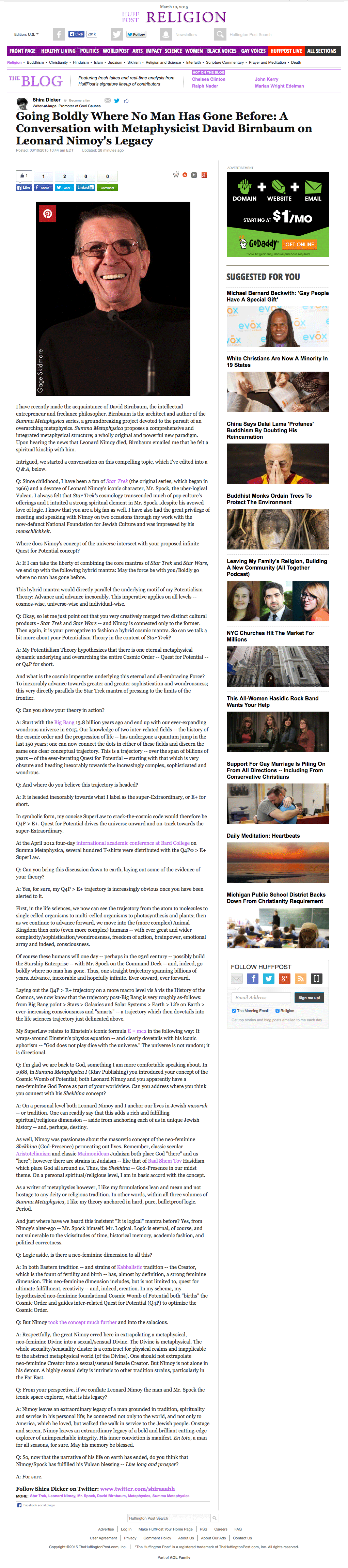
David Birnbaum’s 21st Century Theory of Potentialism

By Viksa Sharma

God and science do not ‘easy bedfellows make.’ It is rare to hear both – God and Science – in the same room unless there is an argument ensuing. Twentieth century science had fought a long, hard battle to remove the spiritual from cosmology. Academic science assiduously endeavored to explain the cosmos as a whole, totally devoid of the possibility of even the possibility of the spiritual; the concerted attempt was to explain the universe in purely physical, scientific terms to the 100% exclusion of any overarching force whatsoever to the Cosmic Order. However, academic science has failed.

Entering the 21st century, someone has stepped up to challenge the failing theories of the last century. David Birnbaum, an independent metaphysicist, philosopher and writer, began a journey in the 1980s to fix our broken understanding of cosmology. Tossing out the failed theory of the last century – Randomness/Atheism – Birnbaum has offered a powerful and elegant fully-integrated new construct (see ParadigmChallenge).

Instead of delegitimizing spirituality, Birnbaum sought to find and embrace the very link between science, faith, spirituality and religion, a link which had dissolved over the last century. Birnbaum crafted his opus magnum trilogy, Summa Metaphysica (see SummaMetaphysica.com). What would broaden into a three part work, Summa Metaphysica I (1988, Ktav Publishing) would redraw the lines of cosmology; the volume would teach a new generation of metaphysicists the science-friendly interrelationship between physical science, spirituality, philosophy and religion. The holy grail of metaphysics – a fully integrated and unified theory – was finally in-hand about 7,000 years into its quest.

Potentialism teaches that the universe is driven by one central prerogative – infinite divine potential – inexorably seeking- after its own inherent potential. Every thing in the universe has a built-in drive to excel – to grow in complexity and become something more than its current state – enroute to the extraordinary. The universe itself follows its own infinite Quest for Potential. Thus, Potentiality is pervasive, eternal and infinite.

Why have we not noticed it? You might in parallel ask – Why do you not notice the air you breathe? Ironically, Potential is so pervasive, it can be invisible even when it is in plain sight. Like the invisible air all around us, it is easy to take it for granted; we give it no notice. Ubiquitous. But its footprint is everywhere.

Once can witness Potential in the way particles wish to become atoms, in the way atoms wish to become molecules, and in the way molecules wish to form larger structures until DNA itself comes together. Likewise, cosmic dust becomes galaxies, galaxies form stars and planets. Potential is everywhere for anyone who wishes to see. Hiding in plain sight.

The Randomness/Atheist construct of the last century thought to deny any overarching drive to the Cosmic Order; scientists of the last century would have us believe the universe – as its major defining feature – is atrophying, decaying and dying. But Birnbaum called out this ‘Emperor’s Clothes’ construct for what it was. The discerned decay is just collateral to the extraordinary and profound growth; ongoing growth and advance is the central dynamic and drive of the Cosmic Order.

In the face of brutal resistance from the hallowed halls of academia, someone finally had the nerve to point out the simple truth: Wherever one looks – the universe is growing, becoming more alive, and filling with diversity and complexity – and richness.

The Need to Destroy God

Potentialism not only shows a universe of life, future, creation and complexity – it shows a universe of intention. This has been one of the reasons atheist academia have attacked Potentialism so vehemently. To be clear, Potentialism is ultimate scientific cosmology. It does not guarantee God Itself exists – at least not in any way a particular religion expresses and defines him. What Potentialism does do, is open the metaphysical possibility for God.

Randomness/Atheism: An Extreme Position

Ironically, even the possibility of the divine, unhinges Randomness/Atheism – for possible God’s existence would destroy the foundation of Randomness/Atheism – which had staked out a simplistic, hard-line position: There is no design/direction/purpose – whatsoever – to our totally aimless universe. While Potentialism is religion-neutral, Randomness is actively, almost virulently, anti-religion and indeed, fanatically anti-purpose.

Why did Randomness academics stake out such an extreme position? Perhaps to align politically with global Atheism and thus build-out a large, natural global constituency. But this extreme position would come back to haunt the Randomness academics with a vengeance when Birnbaum’s Summa – with its formidable and elegant teleology (cosmic purpose) of cosmic quest for potential as central motif – hit the world in 1988

To put it simply, Randomness/Atheism – as its current adherents currently self-define their ideology – can only exist in a universe that has no intention, no drive, no direction, no purpose whatsoever. Their Randomness universe has to be thoroughly random, meaningless and aimless.

The 20th century Randomness/Atheist crew (with center-of-gravity in England) – aided by political support from the global Atheist community – indeed achieved a political hammer-lock on formal academic discussion; formal global academic metaphysics discussion had to be within the parameters of Randomness/Atheism – or face the wrath of Oxford-Cambridge, as bizarre as this sounds.

Locking-in academe irrevocably – which in retrospect was suicidal – gave the very people who have been traditionally tasked with exploring the secrets of the cosmos for us – high-level academe – a vested interest in the skewed results. The very gatekeepers of cosmology have been tainted by a need for (cherry-picked) facts to fit their (fossilized) beliefs.

Galileo would be stunned by the irony that the halls of academia would one day become the mirror-image of the medieval Catholic Church itself which imprisoned him; the Church would militantly attack and debase any independent belief and thought; upholders of cherished medieval Church dogma implacably moved to destroy any beliefs which the Church might not ideologically be able to coexist with; in parallel, the Randomness/Atheism academic junta stifled debate for decades.

The Nature of God

But Potentialism recaptures the place of dynamism in academic discourse. It allows possible ‘space’ in cosmology even for spirituality. To Potentialists, the possible place of potential spirituality is self-evident. In a universe of ‘direction’ and ‘purpose’ which includes thought and morality as well as energy and matter – and, most importantly, an overarching drive of infinite potential – the possible option of spirituality has a natural place.

Potentialism describes a universe of intention. That Intention is the Quest for Infinite Potential. But here is where it gets interesting. If the universe is moving with intention, which it clearly and observably is – does that intention have an intelligence behind it? Or is it a suis generis cosmic intuitiveness? See https://www.summametaphysica.com/theory-outline/.

From the inception of his 3-part masterwork, Birnbaum is quite wary of classic God. To put it mildly, he is wary of the supernatural; but Birnbaum’s Infinite Quest for Potential – is an eternal natural dynamic; and therein lies the extraordinary finesse. The dynamic was ‘hiding in plain sight’, but simply not discerned prior; thus, in one masterstroke, Birnbaum is able to finesse – and unify – philosophy- science-spirituality-religion-metaphysics – with one single hypothesized natural dynamic. See www.SummaCoverage.com.

DAVID BIRNBAUM PHILOSOPHY / METAPHYSICS


Cosmology, Metaphysics & Philosophy: See sample testimonial on Summa Metaphysica, David Birnbaum’s philosophy treatise:


“…Summa represents a bold attempt to formulate a unifying concept of the Universe…it is reasonable to propose the Quest for Potential∞ as a working hypothesis for explaining the impetus behind the cosmic dynamic.”

– Dr. Andrei Alyokhin, Maine, November, 2012,Professor and Graduate Coordinator, School of Biology and Ecology, University of Maine

Harvard/Inductive

David Birnbaum Philosophy

October 7, 2014

Harvard/Inductive

What Ignited our Cosmos?


Deductive v. Inductive approach

Traditional academics have tackled the origins and nature of the universe through deductive reasoning. Looking back in time, they study the nature of the universe as it is and as far back as they can, and deductively try to reason out its secrets and origin. They’ve never succeeded. Looking back in time as the sole path to discerning the secrets of cosmic origins is problematic; the approach ultimately breaks down. It is true that scientists can look back a long way; with the powerful telescopes of today, they can look back very close to the time of the Big Bang, ferreting out many cosmic secrets. But there’s a problem with attempting to deploy that approach alone in tracking back to “the beginning.”

As you go back far enough, the very things which scientists measure begin to lose meaning. When approaching “the beginning” there are unavoidable issues. Indeed, the very word “beginning” loses meaning. In “the beginning” time did not exist. Indeed, matter as we know it did not exist either. Hence, the idea that science can look back all the way to and before the Big Bang through deductive reasoning is pretty much an exercise in futility.
Yeshiva and Harvard-educated David Birnbaum is a Manhattan-based private scholar who engages with these issues. His universe-theory has been featured globally. He employs both paths in-tandem. Since one cannot deduce the eternality of the cosmos simply (deductively) by working backwards in time, one must as well (inductively) start at “the beginning” and work forward.

Birnbaum, in parallel to the ancient Greek metaphysicists, simultaneously starts with a proposed Eternal Origin and works forward towards Theoretical Physics. Birnbaum audaciously wants to seamlessly connect the two, and he apparently succeeds. “Outsider” to the formal academic establishment Birnbaum de facto simultaneously solves the inter-related series of classic (hitherto intractable) problems which has vexed the “insider” academic community.

Now, in order to build a theory inductively, it is important to have a defined set of assumptions which the starting premise (the transcendent dynamic to be discovered) must fulfill. Birnbaum defines these criteria as follows: (1) The system must be elegant. (2) Such a system would most probably be ‘hidden in plain sight,’ as it must be pervasive and universal. (3) Its core dynamic/concept must effectively be eternal. (4) The core dynamic must have a force-multiplier aspect and be able to project and impact infinitely forward.

In 1982 at age thirty-two Birnbaum finally vectored onto the concept/theme/dynamic he had been seeking. It would satisfy all of the above just-noted four criteria. The breakthrough would ultimately herald a possible Intellectual Revolution of the first magnitude – with profound implications.

Birnbaum’s Theory of Potential would be the foundation of Summa Metaphysica – a treatise which would completely redefine current Universal Theory. Summa focuses on Birnbaum’s signature concept of Potential. To Birnbaum, Potential has many faces: Quest for Potential, Infinite Potential, Cosmic Womb of Potential and related. All are different facets of the same universal dynamic.

Birnbaum proposes that Quest for Potential (iterated and nested to the infinite power) ignited and drives the cosmic order. Does this proposal satisfy Birnbaum’s own four criteria?

(1) The proposal definitely satisfies the rule of elegance. The entry-point is simple: potential. But philosophically that simple statement has far reaching ramifications when examining the derivative conclusions this creates. If everything in the universe is pivoted on potential, we humans are potential in corporeal form.

(2) Its all-inclusiveness satisfies rule number two: It is indeed ‘hidden in plain sight’ by virtue of its own omnipresence and intangibility.

(3) Birnbaum daringly posits that Potential is eternal. Stated simply: We all exist; therefore, we all must have had the Potential to exist. Thus, the crucial “bullet proof” dimension of the theory: By definition, Potential is eternal. Its eternality is ultimately self-evident. Thus, its universal nature satisfies rule three as Potential is eternal – by definition.

(4) This Potentiality, when drawn to its logical conclusion, would encompass sub-creations (like humans) from these potentialities as well. Furthermore, what is currently in the universe carries the infinite potential for what can potentially be in the universe. Hence, Potential satisfies the fourth criteria as well.

Birnbaum took this simple, elegant theory and used it to tackle some of the most persistent questions in philosophy: Eternal Origins (his original question), Theogony (the existence and nature of the proposed divine), Theodicy (the problem of evil), Cosmology/Cosmogony (the origins and drive of the universe) and the Teleology Question (the purpose of respectively, both mankind and the universe).

The Manhattan author tackles all these issues in an exhaustive three-part treatise Summa Metaphysica I: Religious Man: God and Evil (Ktav1988); Summa Metaphysica II: Spiritual Man: God and Good (New Paradigm Matrix 2005); Summa Metaphysica III: Secular Man: The Transcendent Dynamic (New Paradigm Matrix 2014). See www.SummaMetaphysica.com.

While Birnbaum is a ‘universalist,’ avoiding judgment in the intense fundamentalist religious v. hard-line atheist argument, his work necessarily addresses these two sides. Unavoidably, Potential Theory provides (a) an eternal divine origin – infinite potential, (b) a scientific “design schema” (c) a scientific alternative to helter-skelter Randomness and (d) a functional theodicy (If God, why evil?) solution. Any one of the four components would be (fatally) radioactive to the entrenched hard-line Randomness-atheistic dogma. Summa shocks the atheistic ‘entrenched dogma’ in the academic community by serving-up all four solutions simultaneously – and via one term (potential).

First, Birnbaum has shown a trajectory from infinity past to the present and onward to infinity beyond of his signature concept of Infinite Potential. The universe journey is not random; it has a direction; one can even hypothesize this dynamic as the core of the Divine.

Second, Summa proposes that there not only is “design” to the universe, but that the designer is science itself. According to Birnbaum Infinite Potential harnessed the eternal equations of Physics-Math to ignite the cosmic order (see ParadigmChallenge).

Third, Summa shows that the alternative to Randomness-atheism is not (supernatural) Creationism, but rather (science-friendly) Potentialism. The entrenched orthodoxy scientific community assumes that to concede any “design” in the universe is to concede that (supernatural) God created it. Birnbaum demonstrated how their key debating premise was a fatally-flawed assumption and argument. The “designer” can be hypothesized to be Birnbaum’s conceptually lean and fully scientific Infinite Potential and not a supernatural Creationist Divinity.

While Birnbaum posits in Summa I that the spark of the divine/religious is inherent in Potential, and uniquely anchors religion metaphysically, he does not stake out a fundamentalist position as axiomatic; rather as a viable option. Birnbaum is not proposing “the supernatural” as the bedrock dynamic; he is proposing “the natural.” His wide-spectrum theory, embracing religion and spirituality as options side-by-side with science, all in turn anchored by Infinite Potential, totally undermines the hard-line atheist arguments that absolutely the only alternative to atheism is Creationism.

Fourth, Summa shows that Potential can be used to address and resolve the pivotal theodicy issue (If God, why Evil?). The inescapable reality is that Summa I resolves the theodicy conundrum, hitherto the salient problem and Achilles’ heel in religious philosophy (also for a long, long time).

This seemingly lethal quadruple-barreled hit on the entrenched Randomness-atheistic dogma has apparently fueled anger, if not panic, in segments of the atheist-controlled academic hierarchy. Believing that they had securely, if not permanently, entrenched their dogma into Academe via squelching all debate, the academic power hierarchy was incensed that Birnbaum had done an end-run around their intellectual blockade via the 4-day international academic Bard Conference which exclusively featured his work. All subsequent attempts by the ‘entrenched dogma’ group to suppress Birnbaum’s theory and suppress his theory have hitherto backfired.

The Transcendent Force

Birnbaum lays out the dramatic 1:1 parallel between his theory (1988, 2005) and the 2006 book of Quantum Physicist Seth Lloyd of MIT. Birnbaum cites Lloyd “The universe computes its own behavior…its own dynamic evolution.” Birnbaum’s Theory of Potential actually elegantly wraps-around Lloyd’s theory and fills-in key gaps. Birnbaum’s theory provides (a) a catalyst, (b) a driver, and (c) a (more sophisticated) goal for Lloyd’s proposed universal quantum mechanism.

Birnbaum’s Infinite Potential itself is the prime mover, the catalyst for life and the alpha and omega. Indeed, it is Infinite Potential which defines the universe and lies at the fount of science, philosophy and spirituality. All three seemingly disparate fields intersect with Infinite Potential at their core; Infinite Potential is the cosmic nexus point.

Accolades from the academic/scientific community

Universally acclaimed metaphysics expert Louis Dupré, Professor of Religious Studies, Yale University (1989) calls Summa I “an original and in this reader’s opinion, a very promising point of view…the author gathers a philosophically coherent and, in the end, highly modern insight…a unified metaphysics…”

Dr. Andrei Alyokhin, Associate Professor School of Biology and Ecology University of Maine wrote in November 2012 “Summa represents a bold attempt to formulate a unifying concept of the Universe…. Therefore, it is reasonable to propose the Quest for Potential as a working hypothesis for explaining the impetus behind the cosmic dynamic.”

Birnbaum’s Potentialism Theory has garnered solid backing from eclectic members of Academe globally (see www.PotentialismTheory.com). In the twenty-six years since it was introduced in 1988, no flaw has been discerned in the metaphysically and scientifically unifying thesis.

Other works

Birnbaum, in addition to Potential Theory, has written a number of other important works including a 7-volume series, which tracks the 4,000 year history of the Jews through important civilizations, titled Jews, Church and Civilization. He is currently editor-in-chief of a potentially landmark 10-volume series on Jewish spirituality Mesorah Matrix scheduled to be released in segments between 2014 and 2019. This series brings together the essay contributions of over 150 Jewish thought leaders from around the world. The series allows Birnbaum, the universalist, to wear a different hat as editor of a series focused on spirituality. But, as he points out, to avoid inserting editorial bias into his metaphysics, he is not an essay contributor to the spirituality series, and his role is strictly as the series catalyst and editor-in-chief.

Context

A Course Text at over a dozen colleges (see SummaCourseText), Summa Metaphysica has been the focus of over seventy feature articles in 2013-2014 alone. See www.SummaCoverage.com.
Summa Metaphysica – and its Theory of Potential – was the focus of a 3+ day international academic conference at Bard College (Upstate, NY) April 2012; the conference, which launched Summa globally, created a global academic firestorm.

Recent hi-level academic works dovetailing with Birnbaum’s Theory of Potential include the following:

Programming the Universe (Knopf, 2006) by Professor of Quantum Mechanics Seth Lloyd of MIT;
Mind & Cosmos (Oxford Press, 2012) by Professor of Philosophy & Law Thomas Nagel of NYU;
Our Mathematical Universe (Knopf, 2014) by Professor of Physics Max Tegmark of MIT.

 

DAVID BIRNBAUM PHILOSOPHY / METAPHYSICS


See sample Summa testimonial on Summa Metaphysica, David Birnbaum’s philosophy treatise:


“We hope to explain the entire universe in a simple formula you can put on your T-shirt.”

– Leon Lederman, Texas, 1983, American experimental physicist, Nobel Prize in Physics

David Birnbaum Metaphysics

Harvard-MIT

www.xMIT1000.com

August 22, 2014

The Theory of Potential & M.I.T.’s Finest

The Theory of Potential & M.I.T.’s Finest


Conceptual Theorist David Birnbaum proposed a cosmological theory in 1988 which the elite American scientific establishment has steadily been edging-up towards. Birnbaum’s construct is the Theory of Potential. Per Birnbaum, eternal Quest for Potential (shorthand notation: Q4P) harnessed the eternal aspects of Physics-Math and ignited the cosmic order (see https://www.summametaphysica.com/theory-core/).

Per Birnbaum, what he labels Complexification (or shorthand notation: C+) – the drive towards ever-greater complexity/sophistication/richness/variety/wondrousness – is the day-to-day dynamic driving this cosmic advance. Another way of looking at this is that Complexification (C+) is the ‘handmaiden’ of (overarching) Quest for Potential (Q4P).

The cosmic goal? Ultimate Potential; the ultimate panoply of the extraordinary; the ultimate gamut of infinite Complexification. And what does Birnbaum label this goal/horizon? Extraordinariation (or E+ for short). See also www.Extraodinariation.com

So, per Birnbaum, infinite Quest for Potential (Q4P) – via its handmaiden Complexification (C+) – drives the Cosmic Order onwards Extraordinariation (E+). Or symbolically, Q4P > C+ > E+. This formula is referred-to as Potentialism’s SuperLaw. See also www.PotentialismTheory.com

Subsequent to Birnbaum’s landmark November 1988 Potentialism work Summa I (Ktav Publishing) – followed by Summa II, March 2005, and by Summa III, January 2014 (the latter two published by New Paradigm Matrix Publishing) – two other directly relevant cutting-edge cosmological theories with variations on C+ have appeared. MIT’s Seth Lloyd (2006) and MIT’s Max Tegmark (mid-2014) have both subsequently proposed breathtaking – but dovetailing to Summa – cosmologies in their respective works, Programming the Universe by Lloyd (First Vintage Books), and Our Mathematical Universe by Tegmark (Knopf).

To Lloyd, the universe is fundamentally computational/information processing; to Tegmark the universe is fundamentally a (dynamic) mathematical structure.

To Birnbaum, either Lloyd or Tegmark – or a hybrid thereof – can be right regarding ‘the mechanics’ of the universe; however, their early 21st century constructs are, in turn possible mechanistic extensions of the prime fount/drive of the cosmic order, Birnbaum’s proposed infinite Quest for Potential (1988).

Conceptually, if the universe operates as a dynamic quantum computer per Lloyd, Birnbaum’s Q4P both architectured it, and is ‘providing the juice’ to run it and advance-it forward. Conceptually, if the universe is a dynamic mathematical structure per Tegmark, Birnbaum’s Q4P designed it, and, again, ‘provides the juice’ to run it and advance-it forward.

The unclosed gap – already previously neatly closed by Birnbaum’s infinite Quest for Potential (1988) – in either Lloyd’s daring theory (2006) or Tegmark’s sophisticated Theory (2014) – is the classic ‘Eternal Origins’ question: What actualized – and drives-forward – that which you posit as centerpiece? What actualized and now drives-forward Lloyd’s universe-quantum-computer? What actualized and now drives-forward Tegmark’s universe-mathematics structure?

Birnbaum’s own (1988) theory is not plagued by the ‘Eternal Origins’ question, because Birnbaum did not start penning his Summa Metaphysica treatise until he was sure he had a powerful resolution of the issue in-place in the metaphysical construct. Indeed, ‘Eternal Origins’ is a key front-and-center pivot of his Theory of Potential.

So why, indeed, is Birnbaum’s Quest for Potential exempt from the ‘Eternal Origins’ dilemma? Because by definition Potential/Possibility is eternal; given that we actually have a universe, is it then not self-evident that Potential/Possibility is/was eternal? Put simply, it is hard to argue that Potential/Possibility has not been eternal, given that we now have reality, for better or worse. If we must choose an eternal dynamic, argues Birnbaum, our optimal choice (by definition and self-evident) is potential/possibility. And indeed, Birnbaum posits his Quest for Potential (infinitely iterating and telescoping-forward) as the core cosmic dynamic.

Thus, Birnbaum’s 1988 Theory of Potential neither fights nor challenges Lloyd’s 2006 theory nor Tegmark’s 2014 theory. Rather, Birnbaum’s theory – or at least the mechanistic zone thereof – is nicely filled-in by the landmark works of Lloyd and Tegmark. Both Lloyd and Tegmark are holistic – embracing a fully integrated universe – as per Birnbaum. Birnbaum’s conceptual drive for infinite Potential wraps nicely around either Lloyd’s quantum-computing universe or Tegmark’s mathematical structure universe – or around both of them in tandem.

Birnbaum was viciously attacked for first proposing this holistic/integrated cosmic order in 1988. At that point, Randomness theory (i.e. all is random chance, happenstance) reigned supreme in academe; at that point it was the ultimate heresy to propose a holistic/integrated cosmology with drive and direction.

Centered at academically powerful Oxford/Cambridge, Randomness was the ‘bully on the block’ – until it received a conceptual shock from Birnbaum’s Theory of Potential; Randomness then received a political/scientific/physics shock from the double-barreled assault from MIT’s Lloyd and Tegmark – which provided quite-formidable ‘covering fire’ to Birnbaum’s holistic/integrated Potentialism.

Now, both Lloyd and Tegmark look at cosmology (pretty much exclusively) through an academic science/mechanistic lens. Birnbaum certainly wants academic science ‘on board’ so to speak, but believes that one has to transcend its confines to truly ‘crack the cosmic code.’ From Birnbaum’s perch, current academic physics/mathematics alone cannot account for the full, pure extent of the complexity/extraordinary, which pervades the universe.

Potentialism is fundamentally a science-based cosmology. But, per Birnbaum, ultimately the cosmic order is not ‘mechanistic’ at its core; rather, at its core the universe is quite ‘profound’. At its core, there is a so-to-speak “X-factor”, a key concept/dynamic transcending classic academic science and philosophy.

Birnbaum relentlessly sought-after that X-factor/profound core; meaning, a core dynamic transcending the confines of classic contemporary scientific-academic thinking. The conceptual theorist’s conclusion: infinite Quest for Potential (infinitely iterating and telescoping-forward).

MIT’s Lloyd and Tegmark provide Birnbaum with crucial political-scientific ‘covering fire vis à vis the Randomness crew; in turn, Birnbaum provides ‘the boys from MIT’ crucial ‘metaphysical conceptual cover’ filling-in the ‘key blanks’ in their respective theories; in particular, Messrs. Lloyd and Tegmark, just what ignited and drives your conceptual mechanistic structure? All three theorists now find themselves in a synergistic mutually-nurturing political-scientific-conceptual relationship.

How did we get from ‘almost nothing’ x billions of eons ago – to Beethoven? By random chance? No, not by random happenstance. Rather, follow the Birnbaum-Lloyd-Tegmark metaphysics road map and discern a cosmic journey – from ‘almost nothing’ to Beethoven’s 5th Symphony.


DAVID BIRNBAUM PHILOSOPHY / METAPHYSICS


Cosmology, Metaphysics & Philosophy: See sample testimonial on Summa Metaphysica, David Birnbaum’s philosophy treatise:


“Each thought leader [Birnbaum of Manhattan(1988, 2005) and Lloyd of MIT(2006)] individually proposes a ground breaking solution. Both of their respective solutions are original, but are nevertheless eerily inter-related and parallel.”

– Frontiers, Dec 21 / 2013

Hawking-Birnbaum: Mind of God

August 6, 2014

Hawking-Birnbaum: Mind of God

broowaha_logo

The Mind of God:

Stephen Hawking v. David Birnbaum

By Viksa Sharma

In 1988 University of Cambridge physicist Stephen Hawking said, “If we do discover a complete theory of the universe…then we shall all, philosophers, scientists, and just ordinary people, be able to take part in the discussion of the question of why it is that we and the universe exist. If we find the answer to that, it would be the ultimate triumph of human reason—for then we would know the mind of God….”

Coincidentally, also in 1988, independent metaphysicist David Birnbaum of Manhattan announced that he had most probably finally uncovered that very complete theory. In his three part Summa Metaphysica series, Birnbaum elucidates his original, powerful and elegant fundamental theory of the universe – the Theory of Potential. At the core of Birnbaum’s theory – his signature concept Infinite Quest for Potential (see SummaMetaphysica.com).

So, post-Birnbaum was Hawking right? Do we now – post-Summa Metaphysica – have an insight into ‘the Mind of God’? It would appear that the answer is ‘yes, definitely.’ Ironically, Birnbaum was publishing a fairly precise and very formal conceptual answer – via his Unified Formulation in Summa I – the same year that Hawking was pondering quite generally – on Cambridge’s picturesque Mathematical Bridge – what an ultimate answer might possibly imply (see https://www.summametaphysica.com/theory-outline/).

Q4P: Quest for Potential

the ubiquitous quest for infinite divine potential via Complexification

In any event, in understanding the fundamental drive of the universe, Birnbaum has found that, in so doing, the theory makes the purpose and direction of the universe clear. The Quest for Infinite Potential(shorthand notation: Q4P) is so pervasive that it is the cause, compass and goal – of the universe. Q4P guides the universe onward; it drives forward the process of Complexification (another Birnbaum-coined term, this one with shorthand notation C+). And just what is C+? This is Birnbaum’s hypothesized natural tendency of the universe is to infinitely strive for higher and higher levels of complexity/sophistication/richness/variety/wondrousness.

Birnbaum further says that the nature of Potential is so universally present that it basically ‘hides in plain sight’ (see PotentialismTheory.com/ParadigmChallenge/). This ‘hiding in plain sight’ is the case, because Potential is literally everywhere; it courses through our bodies; it courses through the universe.
Elaboration: We don’t consciously think of how atoms or molecules form. We don’t think of how planets come together with complex ecosystems or why our planet is so rich in continually evolving life. Mostly though, we don’t usually notice that all of these things have something in common – their increasing Complexification. And that Complexification is a result of the universal and overarching infinite Quest for Potential.

A ubiquitous dynamic? Actually, it’s easy not to notice. Ironically, it is even easier not to notice for those with a scientific background. We can partially thank the relentless scientific indoctrination of atheist Randomness Theory from the previous century for this. We are so constantly conditioned to believe in the entropy/decay of the universe – that it is naturally eroding and falling apart – that we fail to grasp that entropy/decay is but the collateral consequence of the prime cosmic thrust of growth/Complexification. Meaning, the ‘prime directive’ of the cosmic order is actually the very opposite of entropy/decay. And Quest for Potential via Complexification is actually happening right before our eyes – every minute of every day. Whether it is the formation of a drop of water or the creation of a child, the first notes of a symphony or an altruistic act of kindness – if we stop and look, we can see how the universe continues to grow in greater and richer complexity – and even new, varied and wondrous kinds of complexity previously never imagined. And to the Potentialist, this infinite divine quest for potential via Complexification is, indeed, “the mind of the divine” that Hawking spoke of. The ‘mind of God’ is actually a quest. God is not some remote being in some other realm. Infinite divine potential is right here, amongst us, permeating the entire universe and imbuing all of us with its life force and infinite spirit.

Analytically, one only need to juxtapose the theory against the incontrovertible evidence; all data/knowledge/science is efficiently embraced by the elegant and powerful pro-science theory of Potential and Complexification. It only takes a little observation over a longer horizon than is usually deployed.

In 1988, separated by the Atlantic Ocean, and not in direct contact, Hawking in Cambridge proposed, while Birnbaum in Manhattan disposed. The march of intellectual history – and of ideas – is often thus: Two cutting-edge players vectoring-onto the same frequency – and re-pivoting civilization.

DAVID BIRNBAUM PHILOSOPHY / METAPHYSICS

HP USA-Nimoy

March 10, 2015

HP USA-Nimoy

David Birnbaum's philosophy affirms life's spiritual dimension while de facto cracking the cosmic code.

DAVID BIRNBAUM PHILOSOPHY / METAPHYSICS

Huff. Post UK

David Birnbaum Philosophy

January 31, 2014

focus: Potentialism Theory by David Birnbaum

Huff. Post UK

   
huff_top

Two schemas of the Universe

Current Academe is heavily under the sway of a group of academics aligned with what is often referred to as the ‘entrenched orthodoxy’ schema. This schema’s mantra is that the universe is barren and random; its advocates are often atheistic. These advocates, whose geographic center of gravity is at seven leading colleges in southern England, often informally act in tandem, and are often referred to as advocates of Randomness/atheism. As noted, the group propounds that everything is random happenstance and chance. In turn, they assert that mankind is inconsequential in the grand scheme of things, being but a cosmic accident of no significance and importance. To this group, mankind is but an insignificant speck in a cold, random and aimless universe. The group rejects any possibility whatsoever of any transcending force or dynamic or design or spirituality or purpose in the universe. To them the universe is barren. If there is any common denominator to the universe, they would single out ‘decay’. And as far as the billions of extraordinary galaxies, each with billions of extraordinary stars and assorted planetary systems, at least one of which with a quite extraordinary multitude of breathtaking organic bio-forms, well, to them it is just a random event. It all sort of ‘just happened.’

A January 2014 feature article by David Gelernter, professor of computer science at Yale, “The Closing of the Scientific Mind” in Commentary Magazine, puts the scientific and academic community in their place on several inter-related fronts. Gelernter chastises the scientific community for what he terms ‘roboticism, that is, for belittling the role of the aesthetic, the humanistic, and the spiritual. He also criticizes the scientific community at large for being too ‘mechanistic,’ for viewing life entities as if they were pseudo-computers with assorted binary switches.

Wrapping all these inter-related issues together, Gelernter cites the case of NYU Professor of Philosophy Thomas Nagel. In 2012 Oxford University Press published Nagel’s work Mind and Cosmos. The thesis of the work is relatively simple: Contemporary Evolutionary Biology theory (aka ‘the entrenched orthodoxy’) does not ‘handle’ the emergence of consciousness. Nagel, like Gelernter, wants our theory of the cosmic order and its sub-theory of evolution to be richer and to account for human spirit, consciousness and subjectivity. Thus, Nagel feels that there must be a cosmic dynamic driving the universe and evolution forward in a direction which leads to consciousness. He feels that the prevailing orthodoxy, focused only on genetic survival as the sole dynamic in a universe driven only by randomness, is ‘missing the boat’ on what is truly happening here. In technical terms Nagel is proposing that there is a ‘teleology’ (a purpose ‘driver’ of the universe) embedded in the cosmic order.

However, in questioning the entrenched orthodoxy’s failure to explain the emergence of consciousness, Nagel is but a ‘schoolboy’ compared to conceptual theorist and metaphysics specialist David Birnbaum. Nagel suggested in 2012 that there must be a core cosmic ‘drive,’ a teleology. But a major teleology (adroitly handling consciousness in-the-mix) was already published (1988, 2005) by a fellow New Yorker. Nagel’s midtown Manhattan neighbor, 40 blocks north of Nagel at NYU, is David Birnbaum, author of the iconic 2-part philosophical treatise Summa Metaphysica. Birnbaum’s work proposes an overarching cosmic dynamic: Infinite Potential. In November 2013 British journalist Oliver Burkeman, echoed French anthropologist Claude Levi-Strauss (2006) on Birnbaum’s Potentialism, and called Birnbaum’s theory ‘remarkable and profound’; Burkeman felt that both leaders – Birnbaum and Nagel – were nicely in-sync.

Infinite Potential is the centerpiece theme of Birnbaum’s proposed original overarching theory of the cosmic order, the Theory of Potential. Birnbaum’s universe is organic, overflowing with potential. Indeed Potential defines it. If Nagel’s work gives the ‘entrenched orthodoxy’ academics heartburn, then Birnbaum work gives them a massive heart attack. The Birnbaum treatise was published in two parts: Summa Metaphysica I: God & Evil (by Ktav Publishing in1988) and Summa Metaphysica II: God and Good (by New Paradigm Matrix in 2005).

Birnbaum’s Summa, which has over fifty thousand sets in circulation, is actually in full philosophical alignment with Nagel’s later Mind & Cosmos book (2012) and with Gelernter’s above-noted major Commentary article (2014). All their works, so to speak, ‘talk to each other’.

Birnbaum’s Theory of Potential offers a unified, grand and dynamic cosmic construct. Birnbaum is quite aware, as we all are, that there is no shortage of seemingly ‘open space’ in the cosmos. However he suggests not missing the core thrust and embedded potentiality of the cosmic order.

Birnbaum proposes that his signature theme, Infinite Potential, is the eternal and ongoing dynamic of the quite rich cosmic order. What has unfolded over the ages, according to Birnbaum, is far from randomness acting out in a barren universe. “You and I, according to this theory, are individual cosmic potentials, the end-result of many billions of years of ongoing iteration and optimization. In turn, individually, we each set the stage for more potential” says Birnbaum.

There is thus a direct sequence of contemporary protagonists of a so to speak ‘organic’ universe: Birnbaum (1988, 2005) > Nagel (2012) > Gelernter (2014). Nagel in his 2012 work articulated that we should seek to discern the cosmic drive which brought us to life, consciousness, reason, knowledge, language and altruism. It turns out that all of the items on both the Nagel and Gelernter checklists are fully encompassed by Birnbaum’s Theory of Potential. According to Potentialism, the cosmos is organic, not barren. It inexorably quests after its manifold and quite often extraordinary potentials. It seeks the full flowering of its own possibilities. This unstoppable quest for extreme potential drives our quite extraordinary and quite rich universe.


www.summametaphysica.com/huff-post-uk/ ‎

focus: David Birnbaum’s Potentialism Theory

David Birnbaum Metaphysics

IdeasTap

March 3, 2014

focus: Potentialism Theory by David Birnbaum

IdeasTap

IdeasTap_header

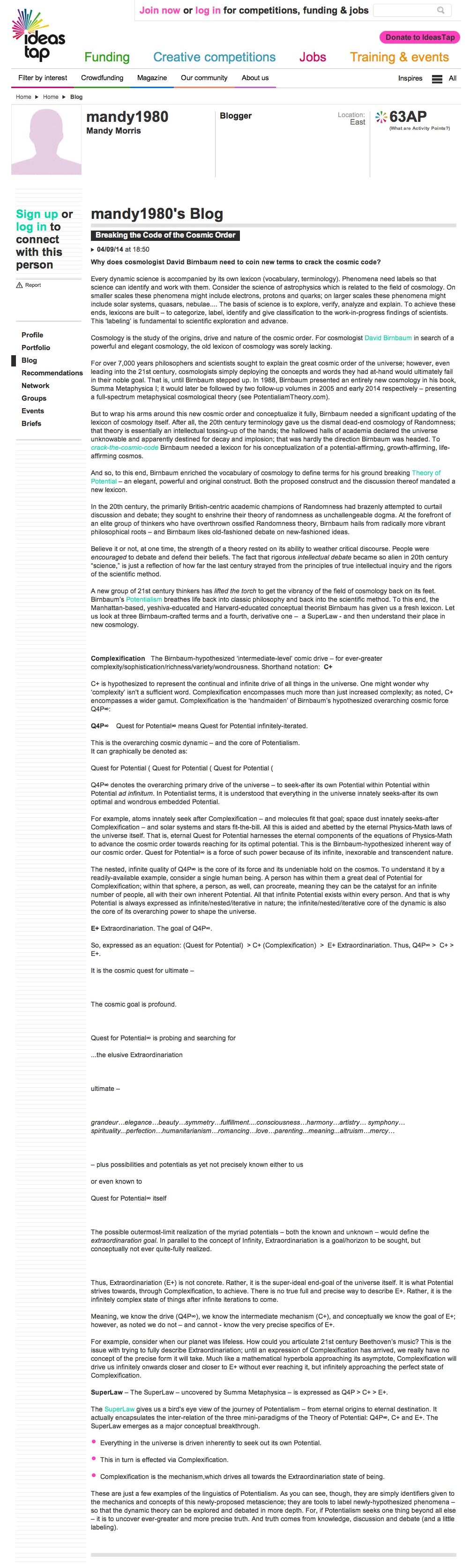
An Imaginary 2014 Discussion: Aristotle and David Birnbaum

03.03.14 at 09:15

The great thinker Aristotle (384 – 322 BCE) has been transported to Manhattan 2014 for a one-on-one with Conceptual Theorist David Birnbaum, author of the Theory of Potential. How does the great Aristotle react to iconoclast Birnbaum’s signature theme – Quest for Infinite Potential?

introductory explanatory note:  Teleology means –purpose of the universe
Aristotle proposed ‘way back’ that the universe had a teleology, but he did not know exactly what it was. As well, Aristotle proposed a ‘prime mover’ (premium movens) of the universe but did not know more exactly what that was either.

Birnbaum proposes that the specific answer to both issues is one-and-the-same. Birnbaum’s theory proposes that there is, indeed, a protagonist to the cosmic order, but that the protagonist is a ‘quest’ and not a ‘classic entity.’ According to the theory, the universe quests for its maximal potential. The core dynamic Quest for Potential strives with purpose towards ever-greater and higher potential. Birnbaum delineates a pure, elegant and powerful scientific theory of design and purpose.

Birnbaum proposes that Quest for Potential (in-tandem with the equations of Physics-Math) is the ‘prime mover; he furthermore proposes that the teleology of the universe is the related – the universe quests for its maximal potential. Thus, ‘potential’ is at the core of both ‘eternal origins’ and the ‘purpose-of-the-universe’ issues.

Birnbaum: Welcome. You’ll be happy to know I’m carrying on your general work of teleology (purpose of the universe) and have crystallized a very specific teleology (i.e. the universe quests for its maximal potentials, what I call extraordinariation).

Aristotle: Oh? You think you’ve found ‘intentionality’ in the workings of the cosmos? And how have you proven this? Through ‘extrinsic’ motivation (for the sake of something external to itself) or ‘intrinsic’ motivation (for the sake of its own self)?

Birnbaum: I beg your pardon?

Aristotle: Well, to prove the universe advances, if you will, with ‘purpose’ – that it drives towards an end goal with intention, you must show that it either functions with ‘extrinsic’ or ‘intrinsic’ finality. More simply, it either moves for the sake of something external to itself – ‘extrinsic’, or for some self-serving goal – ‘intrinsic’.

Birnbaum: Hmm. Actually, I would postulate that a distinction between the two is incorrect.

Aristotle: And how would you defend that assertion?

Birnbaum: ‘Extrinsic’ and ‘intrinsic’ are motivations that belong to a thing – an object or entity in the universe. The Quest for Potential defines the motivational force/quest of the universe itself. Conceptually, nothing exists outside the universe if you consider it contains both its actuality as well as its Potentiality. So, the concept of ‘extrinsic’ v. ‘intrinsic’ is meaningless when applied to the teleology of the universe.

Aristotle: You consider the universe to be the totality of what it is and what it could potentially be?

Birnbaum: Precisely. Philosophically, you must concede that the very nature of the universe is….well, everything. That is, there is no thing you can point to say that it exists, but outside of the universe. Correct?

Aristotle: I’ll concede that.

Birnbaum: Ok. So, let us say I have the idea of writing a paper. Speaking strictly of causal impetus, is not my thought of writing the first step in the chain of reactions that causes the paper to come into existence?

Aristotle: Yes.

Birnbaum: But by Newton’s laws of motion, my apologies, he came after you… but by his Third Law, a body exerting force on a second body will simultaneously exerts a force equal in magnitude and opposite in direction to that of the first body. That is to say, if I push something, that object will receive the energy of my push and move away.

Aristotle: Yes, yes. Your Newton aside, that is all rather self-evident.

Birnbaum: Ah. But my primary mover. The mover that started this chain of physical reactions was a thought. My decision was the first action in the series of reactions to instigate my writing of the paper. By inference, I would have to concede that my thoughts were a force. Perhaps not governed by the same laws as physical bodies, but nonetheless, they are able to manipulate physical objects in the material universe.

Aristotle: Okay. You probably annoy modern physicists very much with that assertion. But logically, this does seem to follow. How does this relate to ‘extrinsic’ and ‘intrinsic’ motivation?

Birnbaum: I would give you this idea to entertain: If thought is physically, or metaphysically if you will – to account for its intrinsically different nature, tied to the physical universe (since it can affect it), then thought is part of the universe in its totality. My challenge to you is tell me something that exists that is external to the universe. If you cannot tell me of any such thing, then the question of ‘extrinsic’ and ‘intrinsic’, in relation to universal teleology, is devoid of meaning.

Aristotle: I see your point. It’s a rather neatly closed argument. If I think of it, it exists in the universe. Even if it is only potential, the thought alone gives it universal presence. Hmm… by extension, anything I can potentially think of exists. The universe would rather unravel itself if this were not so.

Birnbaum: Exactly. This is the pervasive nature of what I call the Quest for Infinite Potential. The very nature of the universe is its own proof. The laws of the cosmos themselves lead unerringly to a universe which is striving to unfold itself to greater complexity – what I call extraordinariation. You’ve nothing to do but look around you at the growing complexity of our universe to see it filling out and expanding and enhancing.

Aristotle: But how do you prove it does so with intent?

Birnbaum: That is where the complexity comes in. There are a million ways the universe could change at random to disintegrate and fall apart, yet on an atomic level, a molecular level, all the way up to intelligent life, we see the universe defy the odds to create, with greater and greater complexity, over and over.

Aristotle: And what do you ascribe this to? Some divinity of creation?

Birnbaum: Not at all. Rather, that is not for me to say with the evidence I have at hand. Certainly, it is obvious there is a prime mover, an alpha, to cosmic order and progress. But ascribing it consciousness/intelligence? It could just as easily be the natural affinity of the universe to grow in such a way. That is why Potentialism is so inclusive of 99% of different beliefs.

Aristotle: Almost. After all, such theories as the (British) Randomness theory cannot survive a teleological universe – even one which doesn’t confirm the existence of a God. Any conclusive assertion of a driving force unravels their entire philosophy. What do you say to that?
Birnbaum: Unfortunately, that’s true and it is a fact I have to live with. We yield that 1%. My theory and the schema of Randomness are mutually exclusive. As much as I would love to extend an olive branch to the hard-line atheist sect of academia, I must profess it is my job to find the truth and tell it, not remake the world into what I wish it was. Sadly, there are plenty doing that already. In the end, wishes won’t change the truth though. And if we’re to progress towards our own Potentiality, someone has to speak that truth.

focus: David Birnbaum’s Potentialism Theory

Ideas Tap: Lexicon

David Birnbaum Metaphysics

September 4, 2014

Ideas Tap: Lexicon

Philosopher David Birnbaum creatively redefines and re-focuses our perception and understanding of human purpose and ultimate reality.

DAVID BIRNBAUM PHILOSOPHY / METAPHYSICS

David Birnbaum Philosophy

Intellectual Pursuit

David Birnbaum Metaphysics

January 16, 2014

focus: Potentialism Theory by David Birnbaum

Intellectual Pursuit

yahoo_header

Intellectual Pursuit versus Collegiate Orthodoxy

In April of 2012, Bard College hosted an academic conference focusing on a philosophical treatise by private scholar David Birnbaum. Twelve months later, that same conference would set off a firestorm of academic censure, personal attacks and outrage from the collegiate establishment. In what can only be described as an attack upon intellectual freedom and critical thinking, Mr. Birnbaum and anyone brave enough to stand for the intellectual and academic legitimacy of the conference would become the target of libel and character defamation.

Aggressively protected by establishment academic circles, the Theory of Randomness postulates that everything in the universe is simply a random occurrence. Vociferously championed by entrenched academics and atheists alike, Randomness seeks to remove the possibility of the spiritual or metaphysical from any universal theory of creation.

Detractors of this theory are quick to point out, however, the inherent intellectual laziness of Randomness. Ensconced within a scientific lexicon, Randomness does little in the way of actual universal explanation – using the blanket theory of “it is simply random” in lieu of logical or material evidence to support and explain. In short, the Theory of Randomness fallaciously uses its own entrenched academic position to self-prove itself.

Understanding Summa Metaphysica

By contrast, Mr. Birnbaum has introduced a unifying theory in his work, Summa Metaphysica. Far from excluding the concept or rightful place of chaos theory, Mr. Birnbaum’s work presents it in its proportionate place alongside philosophical and metaphysical theory. Meaning, that while randomness plays-a-part, it is not the over-riding governing cosmic dynamic, which, in turn obviously yields apparent pattern and design in the cosmic order. Such is the common-sense, self-evident nature of Summa Metaphysic’s Theory of Potential (Frontiers, “Potentialism or String Theory?”).

While any new, divergent theory is, rightfully, subject to intense scrutiny – it is the nature of the attacks upon Summa Metaphysica which are suspect. Indeed, the intellectual core of the Theory of Potential (Theory of Potential, Logical Science, December 2013) seems not to have been criticized at all. Ever. What has transpired, however, has been a relentless string of ad hominem attacks upon any academic brave enough to express confidence in Potential Theory.

Following the conference in 2012, the panelists, the chairman of the conference and even Bard’s President, Leon Botstein, began being pressured by the entrenched academic establishment to distance themselves from the conference and its validity. Mr. Birnbaum himself would be contacted in April of 2013 by a co-chair of the conference, professor Garry Hagberg, and be advised that Professor Hagberg had been in contact with the ‘British academic hierarchy’ (The UK Academic System, PDF) advising him he would need to distance himself from the conference or face academic ruin and isolation. Within the next month, Professor Hagberg, several conference panelists, Dr. Bruce Chilton (chairman of the conference) and the President of Bard itself would all distance themselves from any public support of their very own conference.

However, one panelist stood fast against the intimidation of the academic establishment – Bard Professor of History Gennady Shkliarevsky. Professor Shkliarevsky publicly criticized President Botstein for both abandoning support of the conference and for orchestrating participants to do likewise. Professor Shkliarevsky’s defense notwithstanding, President Botstein’s capitulation to what amounts to external academic coercion has done lasting damage to Bard’s intellectual reputation and integrity.

For his part, Mr. Birnbaum retained high-level legal representation and brought threat of libel and defamation suits against Bard to force it to halt its campaign of discrediting its own conference at the behest of the orthodox academic establishment. Birnbaum also posted online his own set of the conference videotapes, much to the chagrin of Bard which vainly sought to both block the tapes and close down Birnbaum’s very own conference site.

Intellectual Challenges?

While intellectual challenge to any new theory is expected, even encouraged, it begs the question: Why has the academic establishment chosen ad hominem (A Concise Introduction to Logic7th ed., Wadsworth. pp. 125-128, 182) attacks against proponents of Infinite Potential Theory instead of challenging the theory itself directly? Is it perhaps because the theory is too strong? Too elegant? A lethal threat to Randomness Theory? All of the above? Is the Randomness Theory just a ‘house of cards’? Is the Randomness Theory just a 21st century version of ‘the Emperor’s Clothes’?

Infinite Potential is, indeed, a quite-powerful threat to the establishment’s Randomness theory. Ad hominem is a fallacious attack against the messenger when it is intellectually inadvisable to attack the message directly. Where Randomness offers lexical gymnastics, obscure mathematics and circular arguments; Infinite Potential offers self-evident, common sense answers and a unifying theory where religion, science and the metaphysical can coexist cooperatively. Where Randomness postulates that neither religion nor spirituality have any place in reality, Infinite Potential offers a ‘space’ and architecture where all may coexist peacefully and logically. Infinite Potential offers a bridge between the religious, the unknown and the scientific just as a Unifying Theory of Physics offers scientists a bridge between the macroscopic and sub-atomic (International Journal of Modern Physics A15.supp01b, 2000: 840-852).

Despite the virulent personal attacks and threats from the orthodox academic establishment, Birnbaum and his supporters have not only refused to retreat, but have, indeed, doubled down. With his own global set of steadfast academic backers, his philosophy works used at over a dozen colleges, international media focus on him, an international academic email list boasting some two million members, and a theory which has proved unassailable for over twenty-five years, Mr. Birnbaum commands a strong position on the global academic chessboard. He is quietly confident that he will prevail. Reviews by the British press, unlike the British academic establishment, have characterized his work thus far as “remarkable” and “profound”. Birnbaum supporters points out that the opposition – Randomness – is more the absence of a theory, than a bona fide theory.

In Conclusion

Whether Bard will stand on the right side of scientific history might still remain to be seen; however, their pretentious standing on the wrong side of intellectualism has already been established and if the fallacious attacks of Summa Metaphysica’s proponents are any indicator, history will not be kind to Bard.

Albert Einstein made the iconic observation that “God does not play dice with the universe.” (Einstein and the Poet: In Search of the Cosmic Man, p. 58). Summa Metaphysica is in accord. Indeed, it plays-out Einstein’s maxim. Via its Theory of Potential Birnbaum, is tenaciously and steadfastly executing a dramatic global paradigm challenge.

www.summametaphysica.com/intellectual-pursuit/ ‎

focus: David Birnbaum’s Potentialism Theory

21st Century Cosmology, Metaphysics, Philosophy:
Summa Metaphysica elucidates the David Birnbaum philosophy of Cosmic Womb of Potential.

David Birnbaum Philosophy